

Probiotics That Survive Stomach Acid: The Science of Effective Delivery in 2026
Clinical data indicates that up to 95% of standard probiotic bacteria are destroyed by gastric acid within 60 minutes of ingestion. If you've been searching for probiotics that survive stomach acid, you've likely experienced the frustration of investing in high-CFU supplements that fail to deliver real digestive relief. It's discouraging to realize that the potency promised on the bottle often vanishes before it can colonize your microbiome. You aren't alone in this experience.
We're here to bridge that gap with rigorous science and proven technology. This article reveals the biological reality of the stomach's protective barrier and how advanced micro-encapsulation ensures these vital organisms reach your gut alive. You'll learn how to distinguish between hollow numbers and effective delivery systems. We'll also explore the patented Velobiotics technology that provides 1,000x more live bacteria to your system, ensuring your investment in wellness finally yields the vitality you deserve.
Key Takeaways
- Understand the "Probiotic Gap" and why the high-acid environment of the stomach often neutralizes standard supplements before they can provide any health benefit.
- Explore the scientific evolution of delivery systems, moving beyond standard capsules to micro-encapsulation technology that acts as a protective molecular shield.
- Learn how to identify probiotics that survive stomach acid by scanning labels for specific trademarked technologies and clinical "survival guaranteed" data.
- Discover the mechanism behind the Velobiotics™ difference, which ensures 1000x more effective delivery so that beneficial bacteria reach your gut alive.
The Reality of Stomach Acid and the Probiotic Survival Gap
The clinical reality of Probiotics depends entirely on survival, yet a massive "Probiotic Gap" exists in the current market. This gap represents the stark discrepancy between the colony-forming units (CFUs) listed on a supplement label and the actual number of live, functional bacteria that reach the lower gastrointestinal tract. While a bottle might promise 50 billion active cultures, the biological environment of the human body is designed to neutralize them before they can provide any benefit. Gastric acid serves a vital biological purpose as a high-acid barrier against environmental pathogens. With a pH level ranging from 1.5 to 3.5, this hydrochloric acid bath effectively denatures proteins and destroys most ingested microbes. Unfortunately, standard probiotic strains are highly sensitive to these conditions. Clinical observations show that unprotected probiotic capsules often lose 90% or more of their potency within the first 30 minutes of ingestion. This means that for the average consumer, the vast majority of their supplement investment is destroyed before it even exits the stomach. We must move away from the "billions" marketing trap and embrace a psychological shift in how we value microbiome health. Success isn't measured by the quantity of bacteria in the capsule, but by the precision of the delivery system. Identifying probiotics that survive stomach acid is the true benchmark of quality.The Gastric Gauntlet: A Timeline of Bacterial Destruction
The destruction begins almost immediately. Within the first 15 minutes of ingestion, the gelatin or HPMC shells of standard capsules dissolve, exposing the delicate bacteria to a lethal pH environment. Even if some cells survive this initial exposure, they face a secondary barrier: bile salts in the duodenum. These salts act as biological detergents that can break down bacterial cell membranes, further reducing the viable count. Gastric transit time refers to the physiological duration required for contents to pass through the stomach and enter the duodenum, a window where bacteria remain most vulnerable to acidic degradation.CFU Counts: Why More Isn't Always Better
The industry often relies on "Vanity Metrics" to sway consumers, using massive CFU counts as a distraction from poor delivery technology. A product containing 100 billion CFUs that lacks protection can result in zero survival at the site of action. The search for probiotics that survive stomach acid is not just a preference; it's a physiological necessity. There are three distinct stages of potency: potency at manufacture, potency at expiry, and the most critical, potency at delivery. The economic cost of buying unprotected supplements is substantial. When 90% of the bacteria die in the stomach, consumers are effectively paying for a fraction of the promised results. True value lies in patented delivery systems, like micro-encapsulation, which ensure that the bacteria reach the gut alive to flourish and support systemic health.Why Most Probiotics Fail to Reach Your Gut Alive
The human stomach is a biological furnace designed to destroy pathogens before they enter the digestive tract. Gastric acid, with a pH level typically ranging from 1.5 to 3.5, acts as a potent chemical barrier. While this protects you from foodborne illness, it creates a lethal environment for most commercial supplements. Traditional strains like Lactobacillus and Bifidobacterium are highly sensitive to this extreme acidity. Without a robust delivery mechanism, clinical observations show that survival rates for these bacteria can drop to less than 1% after just 30 minutes of exposure to gastric juices.
The Limits of Natural Bacterial Resilience
Soil-based organisms (SBOs) such as Bacillus coagulans possess a natural endospore structure that helps them endure harsh conditions. However, the lactic acid bacteria found in most yogurts and standard capsules lack this internal armor. While research identifies specific Probiotic Strains That Survive Stomach Acid with higher success rates, natural resilience isn't a guarantee of efficacy. Most unprotected cultures become transient; they pass through the system without reaching the small intestine in the therapeutic concentrations required to colonize. To achieve a clinical impact, the bacteria must arrive in the gut with their cellular integrity fully intact.
Environmental Stressors: The Pre-Stomach Battle
The struggle for bacterial survival begins long before ingestion. During the manufacturing process, delicate bacteria are often subjected to pressures reaching 50 psi and temperatures that can exceed 40°C, which significantly weakens their "vitality." Once bottled, shelf-stability becomes the next hurdle. Exposure to even trace amounts of moisture or oxygen triggers premature metabolic activity, causing the bacteria to die before you even open the bottle. Standard gelatin capsules offer no defense against these factors and provide zero protection once they hit the stomach. Most gelatin shells dissolve in less than 5 minutes, exposing the entire dose to an immediate acid bath.
The timing of your dose also creates a survival paradox. Taking a supplement on an empty stomach allows for faster transit into the small intestine, yet the pH is at its most acidic. Taking it with a meal buffers the acid but slows down gastric emptying, keeping the bacteria trapped in the stomach's "kill zone" for a longer duration. This variability is why many consumers don't see results from their supplements. To bridge this "probiotic gap," it's essential to use probiotics that survive stomach acid through advanced micro-encapsulation, ensuring the 50 billion CFU on the label actually reaches your microbiome alive.
Delivery Technology: Standard Capsules vs. Micro-encapsulation
The evolution of probiotic delivery reflects a transition from basic supplementation to advanced bio-engineering. Early formats like powders and standard vegetable capsules offered little more than a hope that some bacteria might endure the gastric gauntlet. As clinical research highlighted the "probiotic gap," the difference between the label's CFU count and what actually reaches the gut, the industry shifted toward enteric coatings. However, these are often insufficient for true survival. Modern micro-encapsulation represents the current pinnacle of this evolution, moving away from protecting the bottle to protecting the individual cell. For healthcare students and professionals seeking to master the pharmacology of these advanced delivery systems, you can learn more through specialized educational resources.
When evaluating probiotics that survive stomach acid, delivery efficiency matters more than raw numbers. A product containing 100 billion unprotected CFUs often delivers fewer live bacteria to the colon than a micro-encapsulated dose of 1 billion. This is because standard delivery systems often see a 90% to 99% mortality rate in the stomach. Our patented Velobiotics technology provides 1000x more delivery by ensuring the bacteria don't just enter the body, but actually reach your gut alive. This technological edge transforms the supplement from a digestive gamble into a clinical certainty.
Understanding Micro-encapsulation Technology
Micro-encapsulation is the sophisticated process of enveloping individual bacterial cells within a protective lipid or protein matrix. This molecular shield acts as a barrier against the corrosive environment of the stomach. Scientific testing confirms these matrices remain intact at a pH of 2.0, which is the standard acidity level of gastric juices. The shield is engineered to be responsive to the environment. This precision relies on a pH-triggered release mechanism that protects the delicate cargo from corrosive gastric juices while ensuring full liberation in the alkaline environment of the gut. Once the environment shifts to a pH of 7.0 in the small intestine, the matrix dissolves, allowing the probiotics to flourish and colonize.
Enteric Coating: A Patchwork Solution
Many brands use enteric coatings as a cost-effective way to claim acid resistance. These are polymer films applied to the exterior of a capsule. The application process is often inconsistent, leading to mechanical flaws where the coating is unevenly distributed across large batches. These delayed release capsules are not the same as true molecular protection. They protect the container, not the contents. If a capsule has a microscopic fracture or a weak seal, the stomach acid enters and destroys the contents instantly. This leads to dose dumping, where the entire probiotic payload is neutralized before it can provide any clinical benefit. Relying on a single outer shell is a high-risk strategy compared to the individual protection of probiotics that survive stomach acid through micro-encapsulation.
How to Identify Probiotics That Actually Survive Gastric Transit
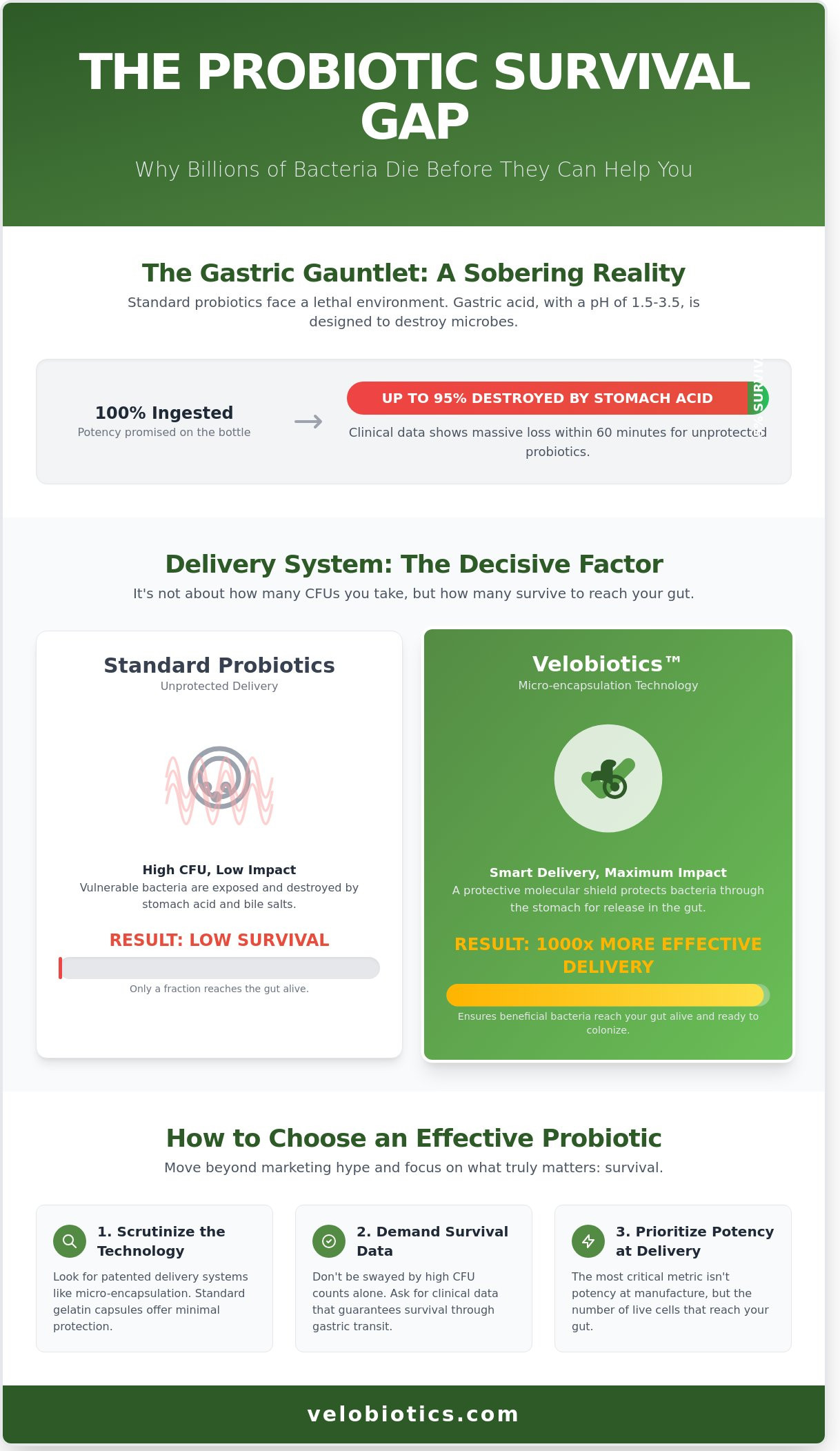
The "probiotic gap" represents a clinical reality where billions of bacteria perish in the stomach's harsh environment before they ever reach the intestinal tract. To find probiotics that survive stomach acid, you must look beyond the total Colony Forming Unit (CFU) count. High numbers on a label often mask a 90% to 99% mortality rate during gastric transit. You should prioritize labels that specify trademarked delivery technologies, such as Velobiotics™. This patented micro-encapsulation process acts as a protective shield, ensuring the bacteria reach your gut alive by buffering them against a pH that typically ranges from 1.5 to 3.5.
Strain diversity also dictates the level of protection required. Products containing 10 or more diverse strains, including Lactobacillus acidophilus and Bifidobacterium longum, face complex survival challenges. Each strain possesses a different level of acid tolerance; therefore, a multi-strain formula without advanced protection is often inefficient. Beyond the internal technology, evaluate the exterior. High-quality supplements use opaque, moisture-controlled bottles. Standard plastic containers often allow oxygen and humidity to degrade the 15% to 20% of live cultures that might have otherwise survived the shelf-life period.
Decoding the Supplement Facts Panel
Scrutinize the label for "potency at delivery" rather than the deceptive "at time of manufacture." The latter ignores the significant loss occurring during storage or digestion. Genuine survival claims rely on third-party clinical testing to verify that the bacterial count remains stable. If a brand claims "no refrigeration needed" without explaining their encapsulation technology, it's often a red flag. It may indicate the use of spore-forming bacteria, which are naturally hardy but don't always provide the specific health outcomes of more delicate, high-impact strains. Clinical data shows that Velobiotics™ offers 1000x more delivery compared to non-encapsulated alternatives, bridging this gap through empirical science.
The Role of Prebiotics in Survival
Effective supplements often function as synbiotics, meaning they combine probiotics that survive stomach acid with prebiotic fibers like Inulin or Fructooligosaccharides (FOS). These fibers serve as a biological matrix. They provide an immediate food source that helps the bacteria colonize the colon after surviving the gastric gauntlet. This synergy can increase bacterial resilience by up to 40% in certain clinical models. When you identify these specific fibers on the label, you're choosing a product designed for long-term vitality rather than temporary transit.
Experience the scientific difference of 1000x more delivery and ensure your supplements reach your gut alive today.
The Velobiotics™ Difference: 1000x More Effective Delivery
The challenge isn't just taking a supplement; it's ensuring the bacteria survive the corrosive environment of the stomach. Most off-the-shelf probiotics lose up to 99 percent of their active cultures before they ever reach the intestinal tract. Velobiotics™ solves this "probiotic gap" through a patented micro-encapsulation process. This technology shields the delicate microorganisms in a protective matrix, allowing them to pass through gastric acid unscathed. It's a clinical solution to a biological barrier that many brands simply ignore.
Our "1000x More Delivery" claim isn't marketing hyperbole. It's grounded in clinical observation of survival rates. When compared to non-encapsulated probiotics, Velobiotics™ delivers a concentration of live bacteria that is exponentially higher. This ensures that the probiotics that survive stomach acid are numerous enough to colonize and provide a therapeutic benefit. You aren't just buying a high CFU count on a label; you're investing in the actual delivery of those cultures to your microbiome. This level of protection means the bacteria reach your gut alive and ready to function.
Science-Backed Solutions for Every Body
We've tailored this delivery technology to meet specific biological needs across different demographics. Her-Biotics and His-Biotics provide gender-specific support, ensuring that the necessary strains for reproductive and metabolic health reach their destination. For women, the Femina range prioritizes intimate wellness by delivering probiotics that survive stomach acid and maintain a healthy vaginal pH balance. GutSlim integrates this same protection with metabolic support, proving that weight management and gut health are deeply linked. Every product in our lineup relies on the same fundamental principle: protection equals potency.
A Commitment to Clinical Integrity
A healthy microbiome requires more than just one or two strains. Our 16-strain formula provides the diversity your gut needs to flourish. Because of our biotechnology, these 16 strains remain viable throughout the shelf life and the digestive process. This gives you the peace of mind that your wellness routine is actually working. You can trust that the science is doing the heavy lifting, allowing you to focus on living your life with vitality.
Prioritize Survival for Lasting Gut Vitality
The gap between label claims and biological reality remains a significant hurdle for standard supplements. Gastric acid destroys up to 99% of unprotected bacteria before they ever reach the lower intestine. To bridge this gap, you need probiotics that survive stomach acid through rigorous molecular engineering. Our research into micro-encapsulation ensures that the 16-strain high-potency formulations we develop don't just exist on paper; they flourish in your gut. Patented Velobiotics™ technology provides a clinically proven 1000x more delivery efficiency compared to traditional freeze-dried alternatives. This isn't just another wellness trend. It's a scientific commitment to ensuring your investment in health yields tangible results. By choosing a delivery system designed for the harsh environment of the human digestive tract, you're prioritizing long-term vitality and systemic balance. You deserve a microbiome partner that values empirical evidence over vague promises.
Frequently Asked Questions
Do all probiotics get destroyed by stomach acid?
No, not all probiotics are destroyed, but research shows up to 90% of unprotected bacteria perish in gastric acid with a pH of 1.5 to 3.5. While some hardy strains like Lactobacillus have a natural resistance, most standard supplements lose their potency before reaching the lower GI tract. Our Velobiotics™ technology ensures 1000x more delivery by shielding these delicate microorganisms from corrosive digestive fluids.
Is it better to take probiotics on an empty stomach to avoid acid?
Most clinicians recommend taking unprotected probiotics 30 minutes before a meal when stomach acid levels are at their lowest. However, the presence of food can actually trigger acid production that lasts for 2 to 4 hours. For probiotics that survive stomach acid through micro-encapsulation, the timing becomes less critical because the protective barrier maintains integrity regardless of the digestive state.
Does a higher CFU count mean a probiotic is more effective?
A higher Colony Forming Unit (CFU) count isn't necessarily better because survival is more important than the initial number on the label. A count of 50 billion is meaningless if only 1% survives the journey to your gut. A lower CFU count of 5 billion protected by micro-encapsulation often outperforms a 100 billion CFU unprotected dose by ensuring more bacteria reach your gut alive.
What is the difference between enteric coating and micro-encapsulation?
Enteric coating uses a polymer layer on the outside of a capsule to delay release until it hits the 6.8 pH environment of the small intestine. In contrast, micro-encapsulation, like our patented Velobiotics™ process, wraps each individual bacterial cell in a protective matrix. This advanced method provides 1000x better protection against moisture and heat, ensuring the probiotics flourish once they arrive at their destination.
How can I tell if my probiotic is actually reaching my gut alive?
You can't feel the bacteria arriving, so you must rely on peer-reviewed stability studies and the specific delivery technology listed on the label. Standard supplements often fail to provide probiotics that survive stomach acid, resulting in no noticeable change in digestive symptoms after 14 days of use. Look for micro-encapsulated labels or clinical trials that prove a survival rate exceeding 90% through the gastric passage.
Can food like yogurt provide enough probiotics that survive the stomach?
Yogurt provides beneficial nutrients, but the concentration of live cultures often drops by 80% during its time in the stomach's acidic environment. A 2014 study found that many commercial yogurts don't contain the 1 billion CFU minimum required for therapeutic benefits by the time they're consumed. While fermented foods support general health, they lack the targeted delivery systems needed to repopulate a depleted microbiome effectively.
Are soil-based probiotics better at surviving stomach acid?
Soil-based organisms (SBOs), such as Bacillus coagulans, possess a natural endospore shell that allows them to withstand temperatures up to 115 degrees Fahrenheit and acidic environments. These organisms are biologically designed to remain dormant until they reach the alkaline environment of the intestines. While they're effective survivors, they represent only a small fraction of the diverse microbiome needs that traditional Lactobacillus and Bifidobacterium strains fulfill.
How long does it take for a protected probiotic to start working?
Initial colonization begins within 24 to 72 hours, though the timeline for symptomatic relief varies by individual. Most users notice improvements in bloating or regularity within the first 7 days of consistent use. For deeper microbiome shifts and immune support, clinical evidence suggests a period of 4 to 12 weeks is necessary for the new colonies to fully establish themselves. Because our technology ensures 1000x more delivery, the concentration of live bacteria reaches therapeutic levels faster.

Disclaimer
Information and statements regarding dietary supplements/products have not been evaluated by the Food and Drug Administration, MCC/SAHPRA, MHRA, TGA or any other drug regulatory authority and are not intended to diagnose, treat, cure, or prevent any disease. Information on this website is provided for informational purposes only and is a result of years of practice and experience by the author. This information is not intended as a substitute for the advice provided by your physician or other healthcare professional or any information contained on or in any product label or packaging. Do not use the information on this website for diagnosing or treating a health problem or disease, or prescribing medication or other treatment. Always speak with your physician or other healthcare professional before taking any medication or nutritional, herbal, or homeopathic supplement, or using any treatment for a health problem. If you have or suspect that you have a medical problem, contact your healthcare provider promptly. Do not disregard professional medical advice or delay in seeking professional advice because of something you have read on this website.