

Lactobacillus Acidophilus Probiotic for BV: The Doctor’s Guide to Restoring Vaginal Balance
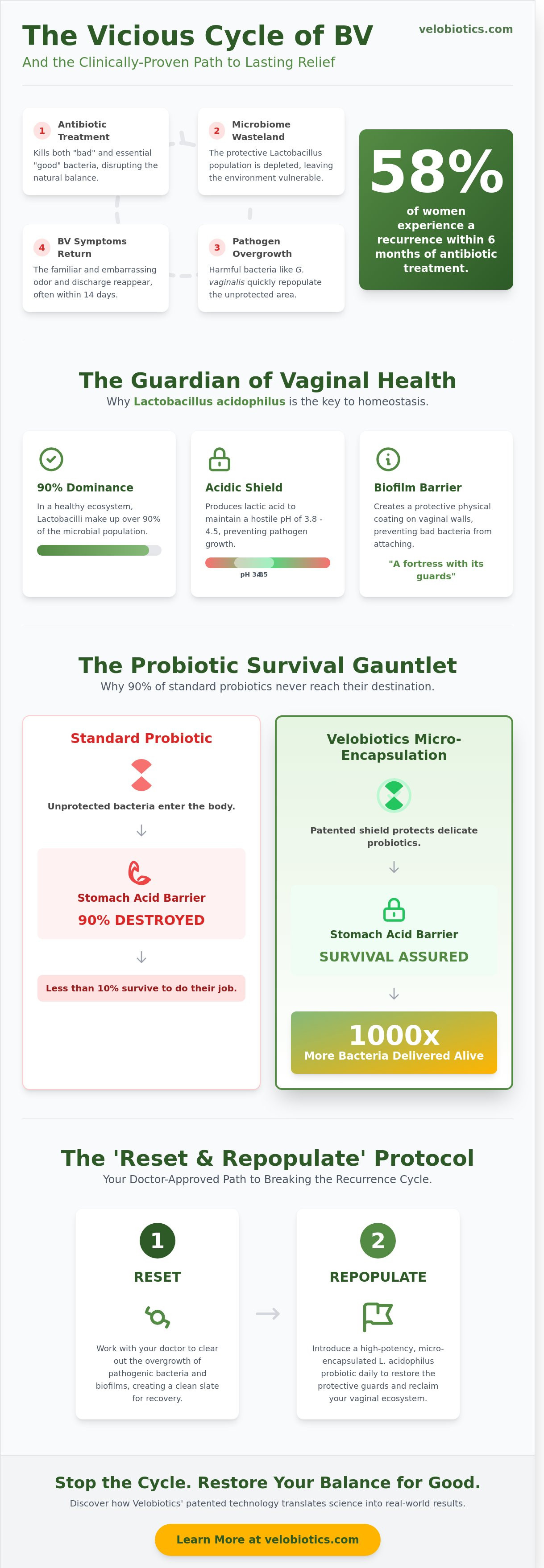
Your standard course of antibiotics might be the very reason your BV keeps coming back. It sounds backward, but while those pills kill off the "bad guys," they often leave your vaginal microbiome a barren wasteland. It's incredibly frustrating to finish a prescription only to have that familiar, embarrassing odor return just 14 days later. You aren't alone. Clinical data shows that up to 58% of women experience a recurrence within six months of treatment because the protective bacteria never moved back in. This is exactly why using a targeted lactobacillus acidophilus probiotic for bv is the most critical step in your recovery process.
As a doctor and researcher, I've seen how the right strain acts as a biological shield, but I also know that 90% of standard supplements are destroyed by stomach acid before they can even start working. I'm going to show you the clinical science behind how L. acidophilus produces lactic acid to lower your pH and why our patented technology ensures 1,000x more bacteria reach their destination alive. You'll discover a clear, actionable protocol to stabilize your vaginal health and finally stop the cycle of recurring infections for good.
Key Takeaways
- Understand why Lactobacillus acidophilus is the "queen" of your microbiome and how it creates a protective shield to maintain vaginal homeostasis.
- Discover why standard antibiotics often fail against biofilms and how a targeted lactobacillus acidophilus probiotic for bv works to dismantle these stubborn bacterial fortresses.
- Solve the "Survival Gap" by learning how to protect delicate probiotics from harsh gastric acid so they actually reach their destination alive and functional.
- Implement our practical, doctor-approved "Reset and Repopulate" protocol to clear out pathogens and restore a flourishing vaginal ecosystem for long-term relief.
- Learn how clinical-grade micro-encapsulation technology provides 1000x more delivery than standard supplements, ensuring the science translates into real-world results.
The Queen of the Microbiome: Why Lactobacillus Acidophilus is Essential for Vaginal Health
As a physician and the founder of Velobiotics, I've spent my career obsessing over the tiny organisms that dictate your health. The vaginal ecosystem is one of the most sophisticated biological environments in the human body. At the center of this world sits a single, dominant ruler: Lactobacillus acidophilus. This bacterium isn't just a resident; it's the primary gatekeeper of your intimate wellness. When we talk about using a lactobacillus acidophilus probiotic for bv, we aren't just adding "good germs" to the mix. We're attempting to restore a natural monarchy that protects your body from inflammation and infection.
Vaginal homeostasis is the clinical term for a state of perfect balance. In a healthy person, Lactobacilli make up over 90% of the microbial population. These bacteria produce lactic acid, which keeps the vaginal pH at a strictly controlled level between 3.8 and 4.5. This acidic environment is hostile to pathogens. When this balance is maintained, your body naturally fends off invaders. However, when these "queen" bacteria are depleted, the door swings open for complications. Restoring this balance requires more than just a standard supplement; it requires a delivery system that ensures these delicate cells reach their destination alive and ready to colonize.
To better understand this concept, watch this helpful video:
What Makes L. Acidophilus Different from Other Strains?
The name "Acidophilus" literally translates to "acid-loving." This is a crucial distinction. While many probiotic strains are designed to support digestion in the gut, L. acidophilus is uniquely adapted to colonize vaginal epithelial cells. It creates a physical biofilm, a protective coating over the vaginal walls that prevents "bad" bacteria from sticking. Most off-the-shelf probiotics fail because they use generic gut strains that cannot survive the journey or lack the specific binding proteins needed for vaginal health. Our research into micro-encapsulation ensures that these specific strains survive gastric acid, providing a targeted approach that you can find in specialized formulas like Femina probiotic capsules.
The Link Between Low Lactobacillus and BV
Bacterial Vaginosis (BV) occurs when the "void" left by missing Lactobacilli is filled by an overgrowth of anaerobic bacteria, most notably Gardnerella vaginalis. This isn't just an "infection" in the traditional sense; it's an ecological collapse. Without the lactic acid and hydrogen peroxide produced by L. acidophilus, the vaginal pH rises, allowing pathogens to flourish and trigger symptoms like odor and discharge. Your vaginal microbiome acts as your first line of immune defense. A vagina without L. acidophilus is like a fortress without its guards. By introducing a high-quality lactobacillus acidophilus probiotic for bv, we are effectively rehiring those guards to reclaim the territory and restore the protective barrier your body relies on.
The Science of Defense: How L. Acidophilus Actually Defeats BV
Ever wonder why that "fishy odor" is so persistent? It's not just a random scent; it's a chemical byproduct of a bacterial takeover. When pathogens like Gardnerella vaginalis dominate your microbiome, they produce compounds called amines. These amines are responsible for the distinct smell that sends many women rushing to the doctor. Using a lactobacillus acidophilus probiotic for bv isn't just about masking a symptom. It's about changing the chemistry of your body to stop those amines from forming in the first place.
One of the biggest hurdles in treating BV is the "biofilm" problem. Think of a biofilm as a microscopic fortress. Bad bacteria don't just float around; they glue themselves to your vaginal lining, creating a sticky, protective shield. This shield is why nearly 50 percent of women experience a BV recurrence within six months of finishing antibiotics. Antibiotics often kill the free-floating bacteria but leave the fortress intact. L. acidophilus uses a mechanism called competitive inhibition. It essentially "takes up all the parking spots" on your vaginal walls, making it physically impossible for bad bacteria to latch on and build their fortresses.
This biological warfare is well-documented. A scientific study on L. acidophilus for BV highlights how these beneficial strains produce antimicrobial substances that directly target pathogens. By introducing a consistent supply of these "good guys," you're reinforcing your internal security team.
Lactic Acid: The Natural pH Regulator
Your vaginal environment needs to be acidic to stay healthy. L. acidophilus acts as a tiny chemist, converting glycogen from your vaginal cells into lactic acid. This process maintains a strict pH balance between 3.8 and 4.5. Most BV-causing bacteria are incredibly sensitive to acid; they simply can't survive in an environment that's below a 4.5 pH. It's your body's most effective security fence.
Hydrogen Peroxide and Biosurfactants
L. acidophilus has a few more tricks up its sleeve. It produces hydrogen peroxide (H2O2), which is lethal to the anaerobic bacteria that cause BV. These bad bacteria thrive in low-oxygen environments, so a steady drip of H2O2 acts like a natural antibiotic without the scorched-earth side effects of prescription drugs. Additionally, L. acidophilus secretes biosurfactants. These act like a "non-stick coating" for your vaginal walls, preventing pathogens from sticking and colonizing. For a clinical-grade way to boost these natural defenses, you might explore Femina Probiotic Capsules to ensure these strains reach the areas where they are needed most.
Oral vs. Vaginal Probiotics: Solving the Survival Gap
I hear it every day in my clinic: "Doctor, I’ve been taking probiotics for months, but my BV keeps coming back." It’s incredibly frustrating. You spend money on high-potency supplements, yet the results don't follow. The reason isn't usually the bacteria itself; it’s the delivery method. We call this the "Probiotic Gap." It is the massive difference between the number of live cultures printed on your supplement bottle and the tiny fraction that actually reaches your system alive. If the bacteria don't survive the journey, they can't do the work of restoring your vaginal balance.
The Gastric Acid Barrier
Your stomach is a literal vat of hydrochloric acid designed to destroy pathogens. Unfortunately, it doesn't distinguish between "bad" bacteria and your expensive lactobacillus acidophilus probiotic for bv. Research indicates that up to 99% of standard, unprotected probiotics are wiped out within 30 minutes of exposure to gastric juices. A 50 billion CFU supplement is useless if 49.9 billion are killed by your stomach acid. This biological incinerator is why many women feel like probiotics "don't work" for them.
To solve this, we focus on technology that offers 1000x more delivery than standard capsules. It isn't about how many billions you swallow; it's about how many billions reach your gut and eventually migrate to the vaginal tract. You can dive deeper into the science of Probiotics That Survive Stomach Acid to see how micro-encapsulation changes the game for effective delivery.
Vaginal Suppositories: Direct Repopulation
Sometimes, the direct route is the smartest choice, especially during an acute BV flare-up. Vaginal suppositories bypass the digestive "gauntlet" entirely. By placing the lactobacillus acidophilus probiotic for bv exactly where it is needed, you provide immediate localized support. This allows the beneficial bacteria to adhere to the vaginal wall and begin producing lactic acid right away. This Mayo Clinic on acidophilus overview confirms that while oral use is common, direct application is a widely researched tool for managing vaginal health.
For those dealing with stubborn odor or discharge, a dual approach often works best. Using a targeted product like Femina Probiotic Cookie Fresh combines the pH-balancing power of boric acid with direct probiotic repopulation. This helps your microbiome flourish by creating an environment where pathogens can't survive while the "good guys" get a head start on colonization. Whether you choose oral or vaginal delivery, the goal remains the same: ensuring the bacteria stay alive long enough to actually help you heal.
The 'Reset and Repopulate' Protocol: Breaking the Recurrent BV Cycle
If you're stuck in a loop of recurring infections, you aren't alone. Clinical data shows that nearly 50% of women experience a relapse of Bacterial Vaginosis within 12 months of antibiotic treatment. I've spent my career studying the microbiome to understand why. The answer lies in the "biofilm," a sticky, protective shield that Gardnerella bacteria build around themselves. Antibiotics often kill the floating bacteria but fail to penetrate this fortress. To break the cycle, we need a two-step clinical strategy: we reset the environment and then we repopulate the community.
Step 1: The pH Reset with Boric Acid
Think of Boric Acid as a biological reset button. It doesn't just lower the vaginal pH to its ideal acidic range of 3.8 to 4.5; it acts as a mild antiseptic that physically breaks down the bacterial biofilm. When that shield is gone, the "bad" bacteria are exposed and vulnerable. This is a critical first step because trying to add good bacteria to a crowded, biofilm-heavy environment is like trying to plant seeds in concrete.
For patients starting this journey, I recommend a clean, medical-grade option like Femina Cookie Fresh Boric Acid Only. It's vital to remember that Boric Acid is strictly for vaginal use; you must never swallow these capsules. Use them for 7 to 14 days to clear the "room" before moving to the next phase.
Step 2: Repopulating with L. Acidophilus
Once the reset is complete, you have a "blank slate." If you leave it empty, the opportunistic Gardnerella will simply move back in. This is the critical window where you must introduce a high-quality lactobacillus acidophilus probiotic for bv. By flooding the environment with L. acidophilus, you're essentially hiring a security team to guard the doors. These beneficial bacteria produce lactic acid and hydrogen peroxide, which naturally inhibit the growth of pathogens.
Consistency during this maintenance phase is what separates success from failure. I suggest a transition from vaginal suppositories to a daily oral regimen. However, there's a catch: standard oral probiotics often die in your stomach acid before they ever reach their destination. This is why our Velobiotics™ technology is so vital. It protects the bacteria, ensuring 1000x more delivery of live cultures to your system. To keep the "rebound" at bay, aim for a daily dose of lactobacillus acidophilus probiotic for bv for at least 90 days to establish a permanent colony.
Ready to move from a temporary fix to long-term vaginal health? Start your maintenance journey with Femina Probiotic Capsules and give your microbiome the protection it deserves.
Choosing the Right Support: Why Velobiotics Technology Changes the Game
As a physician, I've seen countless women struggle with the frustrating cycle of recurring imbalances. The problem often isn't the bacteria themselves, but the delivery method. Most off-the-shelf supplements are fragile; they're often dead before they even leave the pharmacy shelf or destroyed by your stomach acid within minutes. I founded Velobiotics to bridge this gap between clinical potential and real-world results. We developed a way to ensure your lactobacillus acidophilus probiotic for bv actually survives the journey to where it's needed most.
The Science of Micro-Encapsulation
Our patented Velobiotics™ technology is a revolutionary shield for microscopic life. We use a unique process to wrap each probiotic strain in a protective matrix that guards against heat, moisture, and the intense acidity of the stomach, which typically maintains a pH between 1.5 and 3.5. While standard probiotics can lose up to 90 percent of their potency before they ever reach your intestines, our technology ensures 1000x more delivery of live, active cultures.
This "reach your gut alive" guarantee is the cornerstone of our brand. By protecting the L. acidophilus through the harsh digestive environment, we provide the high-concentration support necessary to crowd out "bad" bacteria and restore a healthy vaginal pH. You can learn more about our commitment to clinical excellence by reading the Velobiotics Story.
The Femina Line: Targeted Solutions for Women
We designed the Femina line with a "Cookie Fresh" philosophy in mind. Intimate wellness shouldn't feel like a clinical burden or a source of dread. It's about maintaining vitality and confidence through proactive care. For women who need comprehensive support, our Femina Probiotic Capsules with Cranberry provide a sophisticated dual-action defense. These capsules deliver the specific lactobacillus acidophilus probiotic for bv strains required for vaginal balance while adding the protective benefits of cranberry for urinary tract health.
Our formulations are grounded in over 10 years of microbiome research and are built for the reality of a busy lifestyle. You don't have time for products that don't work. By choosing doctor-led technology, you're investing in a solution that respects the complexity of your body. Take control of your microbiome and give your body the high-tech support it deserves to flourish. You've got the power to stay balanced, and we've got the science to make sure you stay that way.
Take Control of Your Vaginal Health
Understanding the science behind your microbiome is the first step toward lasting comfort. Most standard supplements fail because the bacteria die before they can help you. When you prioritize a lactobacillus acidophilus probiotic for bv, you're utilizing the most researched strain for vaginal defense. This strain maintains a healthy pH of 4.5 by producing lactic acid, which keeps pathogens at bay. It's a simple biological mechanism that requires the right delivery system to work effectively.
I founded Velobiotics to bridge this technical gap with clinical precision. Our patented Velobiotics™ Micro-encapsulation technology ensures 1000x more probiotic delivery than standard capsules. This means the active cultures actually reach their destination to repopulate your flora. You don't have to settle for temporary fixes or constant recurrence. By choosing a doctor-founded solution designed for survival, you can finally break the cycle and restore your natural harmony.
Stop the BV cycle with our Doctor-Formulated Femina Cookie Fresh Suppositories
You deserve to feel balanced and confident every day.
Frequently Asked Questions
Can I take Lactobacillus acidophilus while on antibiotics for BV?
Yes, you can and should take Lactobacillus acidophilus while on antibiotics for BV. Antibiotics like Metronidazole are effective at killing harmful bacteria, but they also wipe out up to 90% of your beneficial vaginal flora. By introducing a high quality probiotic during your course, you help maintain a protective shield. Just remember to space your probiotic dose at least 2 hours apart from your antibiotic to ensure the bacteria reach your system alive.
How long does it take for L. acidophilus to work for BV symptoms?
Most women notice a reduction in discharge and odor within 7 to 14 days of consistent use. Clinical studies indicate that vaginal pH levels often begin to stabilize after 7 days of daily supplementation. For long term balance, I recommend a 30 day regimen to ensure the lactobacillus acidophilus probiotic for bv fully colonizes and creates a dominant, healthy microbiome that keeps pathogens away.
Is it better to eat yogurt or take an Acidophilus supplement for BV?
A targeted supplement is significantly more effective than yogurt for clinical results. While a cup of yogurt contains roughly 1 billion CFUs, most of these bacteria perish in your stomach's gastric acid before they can help you. Our Velobiotics™ technology provides 1000x more delivery by protecting the bacteria in a micro-encapsulated shield. This ensures the active cultures actually survive the journey to where they're needed most.
Can I use L. acidophilus suppositories during my period?
You can use them, but it's often less effective because menstrual blood has a pH of 7.4, which is much more alkaline than a healthy vaginal environment. This shift can interfere with how well the probiotic colonizes. I suggest switching to an oral micro-encapsulated probiotic during your cycle. It's less messy and ensures a steady stream of beneficial bacteria reaches your microbiome regardless of your monthly flow.
Are there any side effects of taking L. acidophilus for vaginal health?
Side effects are rare and usually very mild. About 5% of new users might experience slight gas or bloating during the first 48 hours as their internal ecosystem recalibrates. These symptoms typically vanish quickly as your body adjusts to the new, healthy bacterial load. If you have a compromised immune system, always consult your medical team before starting any new supplement regimen to ensure total safety.
What is the recommended CFU count for a vaginal probiotic?
For vaginal health, you should look for a supplement providing between 5 billion and 10 billion CFUs per dose. However, the raw number on the label matters less than how many bacteria actually reach your gut alive. Using a lactobacillus acidophilus probiotic for bv with micro-encapsulation ensures that even a standard dose delivers the punch of a much larger, unprotected one by bypassing harsh digestive acids.
Can L. acidophilus help prevent yeast infections as well as BV?
Absolutely, because L. acidophilus produces lactic acid and hydrogen peroxide, which create a hostile environment for Candida yeast. Research shows that women with high levels of Lactobacillus have an 80% lower risk of developing recurrent yeast infections. By maintaining an acidic environment around pH 4.5, these "good guys" prevent both fungal overgrowth and the bacterial imbalances that lead to BV.
Is it safe to use L. acidophilus probiotics during pregnancy?
It's generally considered safe and even beneficial, as roughly 25% of pregnant women experience some form of bacterial imbalance. Maintaining a healthy microbiome is crucial during this time for both mom and baby. I always tell my patients to double check with their OBGYN first, but clinical data from the last 20 years suggests that probiotics are a reliable way to support vaginal health during all three trimesters.

Disclaimer
Information and statements regarding dietary supplements/products have not been evaluated by the Food and Drug Administration, MCC/SAHPRA, MHRA, TGA or any other drug regulatory authority and are not intended to diagnose, treat, cure, or prevent any disease. Information on this website is provided for informational purposes only and is a result of years of practice and experience by the author. This information is not intended as a substitute for the advice provided by your physician or other healthcare professional or any information contained on or in any product label or packaging. Do not use the information on this website for diagnosing or treating a health problem or disease, or prescribing medication or other treatment. Always speak with your physician or other healthcare professional before taking any medication or nutritional, herbal, or homeopathic supplement, or using any treatment for a health problem. If you have or suspect that you have a medical problem, contact your healthcare provider promptly. Do not disregard professional medical advice or delay in seeking professional advice because of something you have read on this website.